
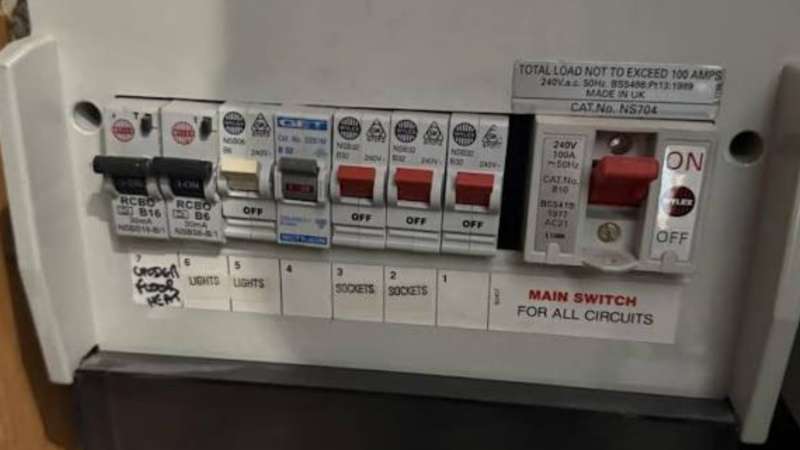
Most people give little thought to the wiring inside their property until something stops working. Lights switch on, appliances receive power and sockets appear to function as expected. However, everyday electrical performance does not necessarily tell the whole story about the condition of an installation.
A building may contain wiring that has been altered several times, protective equipment that has deteriorated or electrical connections that are no longer performing as intended. These conditions may go unnoticed during ordinary use.
An EICR certificate provides a way to examine the condition of a property’s existing electrical installation. Through inspection and testing, an electrician can identify safety concerns, record the results and advise whether corrective work is necessary.
This is particularly relevant to landlords, who must meet specific electrical safety obligations for covered rental properties in England. It is also useful for homeowners who want to understand an older installation and businesses responsible for maintaining safe working environments.
Safety Spectrum London carries out electrical inspection and testing for residential and commercial properties across London.
The following guide explains what an EICR tells you, how testing is carried out, what the inspection costs may depend on and how to respond to the findings.
What Does an EICR Actually Tell You About a Property?
An Electrical Installation Condition Report, usually shortened to EICR, describes the condition of an existing fixed electrical installation following professional inspection and testing.
Its purpose is not to assess whether every appliance in a building works correctly. Instead, it considers the electrical infrastructure that distributes electricity throughout the premises.
This distinction matters because electrical problems can exist within the installation even when individual appliances continue to operate normally.
An inspector looks at the arrangements used to distribute electricity, the effectiveness of protective measures and the condition of accessible electrical equipment.
The examination can include consumer units, wiring systems, distribution boards, switches, socket outlets, earthing arrangements and circuit protection.
Electrical test instruments are also used to obtain measurements that cannot be established simply by looking at components.
The findings are documented in a report that identifies the inspection scope, relevant defects, test results and the inspector’s overall assessment.
The result provides a useful starting point for deciding whether the installation can remain in service without identified remedial work or whether further action is required.
Although frequently described as an electrical safety certificate, an EICR is more accurately a professional report on the condition of an installation at a particular point in time.
Property owners searching for an electrical safety certificate in London can contact Safety Spectrum London to discuss the appropriate inspection for their premises.
Why Can Electrical Faults Remain Hidden for Years?
Electrical deterioration does not always cause an immediate power failure. In some situations, a circuit may continue to operate despite having a defect that increases the risk of danger.
Consider a socket outlet that has been repeatedly used for high-demand equipment. The accessory may still deliver electricity, while a deteriorating connection behind it goes unnoticed.
Older wiring systems may also have experienced previous alterations, changes in electrical demand or environmental conditions that affect their long-term performance.
Other installations may contain protective equipment that no longer provides the level of protection expected.
These examples demonstrate why judging electrical safety from everyday performance alone can be misleading.
What Can Go Wrong With an Electrical Installation?
Several types of problems may develop as a building ages or its electrical system is modified.
Deteriorating wiring insulation
Electrical cables rely on insulation to prevent unintended contact with conductive parts. Ageing, heat, physical damage or unsuitable installation conditions can affect that protection.
Poor electrical connections
Connections that are loose or damaged may generate excessive heat. Depending on the circumstances, this can contribute to equipment damage or fire risk.
Inadequate earthing arrangements
Earthing and protective bonding form part of the arrangements used to reduce electric shock risk. Deficiencies in these measures can have serious consequences during electrical faults.
Damaged electrical accessories
Cracked switches, deteriorated socket outlets and other damaged accessories may create hazards that should be investigated.
Unsuitable protective devices
Circuit breakers and residual current devices serve different protective functions. Their suitability and operation are important considerations during an inspection.
A properly conducted EICR helps identify relevant problems and records them in a format that property owners can use when planning repairs.
Who Should Consider Booking an EICR Inspection?
Not every building has identical electrical inspection obligations. The appropriate approach depends on how the property is occupied and the responsibilities of the people managing it.
Landlords Managing Rental Accommodation
For landlords, electrical testing is an important part of meeting applicable safety requirements.
An EICR provides documented information about the fixed wiring and related electrical equipment within the inspection scope.
The report also helps establish whether the landlord needs to arrange repairs, improvements or additional investigation.
Homeowners Assessing an Existing Installation
People who own and occupy their homes may arrange an EICR to gain a better understanding of the condition of the electrical system.
This can be useful when purchasing an older property, planning extensive refurbishment or reviewing wiring that has not been inspected for a long time.
An inspection may also be appropriate following significant electrical damage or where there are concerns about previous installation work.
Letting Agents and Property Managers
Managing several properties creates additional administrative responsibilities.
Inspection dates, electrical reports, repair quotations and evidence of completed work all need to be organised.
A consistent process for arranging EICRs can help property managers track electrical safety information across their portfolios.
Commercial Property Owners and Businesses
Commercial premises may contain more demanding electrical systems than residential accommodation.
Offices, restaurants, shops and industrial buildings can have numerous circuits, multiple distribution boards and specialist electrical equipment.
An EICR assists those responsible for these installations in understanding their condition and identifying electrical issues requiring attention.
What Are the EICR Rules for Landlords in England?
Electrical safety legislation places particular obligations on landlords of rented accommodation within its scope.
Under the Electrical Safety Standards in the Private Rented Sector and Social Rented Sector (England) Regulations 2020, as amended, covered properties must undergo electrical inspection and testing at the prescribed intervals.
The general requirement is for an inspection at least once every five years, although the existing report may specify that the next assessment should happen sooner.
The inspection must be undertaken by a qualified and competent person.
However, arranging the inspection is only one part of the landlord’s responsibility.
What Happens After the Inspection?
Once the report is produced, landlords must make it available to the relevant people within the applicable deadlines.
For covered properties, the reporting requirements include giving existing tenants the report within 28 days of the inspection and providing new tenants with the current report before occupation.
A prospective tenant who requests the report must be supplied with a copy within 28 days.
If the local housing authority requests the document, the landlord must provide it within seven days.
These requirements are intended to ensure that the condition of the installation is documented and that the relevant parties can access the findings.
What If the Report Identifies a Problem?
Where the report identifies remedial or investigative work that is required under the regulations, the landlord must ensure that the necessary action is taken.
The usual deadline is 28 days, but an earlier deadline applies where specified.
Once the work has been completed, appropriate written confirmation must be obtained. The applicable regulations also require this documentation to be provided to tenants and the local housing authority within the prescribed timeframe.
Landlords can consult the official government guidance on electrical safety standards for further information about the legal requirements and their application.
What Should You Expect When an Electrician Visits for an EICR?
An electrical inspection involves a combination of observation, measurements and professional judgement.
The exact sequence varies between buildings, but the inspector needs to establish the extent of the installation, examine relevant components and undertake appropriate testing.
Before Testing Begins
The electrician may first discuss the building’s electrical arrangements and any known issues.
Information about previous alterations, recurring circuit problems or areas with restricted access can be useful.
The inspector also determines which parts of the installation can be examined and records any limitations that affect the assessment.
Examining Accessible Equipment
The physical inspection focuses on the condition of accessible electrical components.
For example, the electrician may examine the consumer unit for signs of overheating, damage or inappropriate arrangements.
Socket outlets, switches, visible cables and other components may also be checked where accessible and included within the agreed scope.
The inspector considers whether protective arrangements are suitable and whether there are obvious conditions that could cause danger.
Measuring Electrical Performance
Visual checks cannot reveal every potential defect.
For this reason, the electrician uses specialist instruments to carry out relevant tests.
These may include insulation resistance measurements, continuity checks, polarity verification, earth fault loop impedance measurements and tests of residual current devices.
Each test provides information about a particular aspect of the electrical installation.
Certain procedures require circuits to be switched off temporarily. Occupants should therefore make suitable arrangements for any necessary interruptions to the electricity supply.
Reviewing the Findings
Following the inspection, the electrician evaluates the results and records observations that require attention.
The report will indicate whether the installation is satisfactory or unsatisfactory for continued service, taking account of the findings and any recorded limitations.
It will also contain relevant inspection and test details, together with a recommended date for the next assessment.
Safety Spectrum London offers residential EICR inspections for landlords, homeowners and property managers throughout London.
How to Read an EICR Without Being an Electrician
An EICR contains technical information, but property owners do not need to understand every electrical measurement to identify its main conclusions.
The first thing to check is the overall assessment.
If the installation is recorded as satisfactory, the inspector has not identified observations requiring an unsatisfactory outcome within the agreed scope.
An unsatisfactory result means that relevant problems have been identified.
The observations section then provides more detail about those findings.
What Do the EICR Classification Codes Mean?
| Code | What it indicates | Why it matters |
| C1 | Danger Present | Immediate action is necessary to remove or make the danger safe. |
| C2 | Potentially Dangerous | The condition requires urgent remedial attention. |
| C3 | Improvement Recommended | An improvement is advised, but this code alone does not make the report unsatisfactory. |
| FI | Further Investigation Required | The issue needs additional investigation without delay to establish whether danger exists. |
The distinction between these classifications is important.
A C3 observation may identify an opportunity to improve an installation without making the overall report unsatisfactory.
By contrast, C1, C2 and FI observations normally result in an unsatisfactory assessment.
For a property owner, the most useful approach is to discuss the recorded observations with the inspecting electrician and establish precisely what work is required.
Does an Unsatisfactory EICR Mean the Property Needs Rewiring?
Not necessarily.
An unsatisfactory result indicates that the inspector has identified one or more defects requiring remedial action or further investigation.
The extent of the necessary work depends on what those defects are.
In some situations, the issue may concern a particular socket outlet, an electrical connection or an individual protective device.
Other findings may relate to more extensive wiring problems or deficiencies affecting several circuits.
A complete rewiring project should not be assumed simply because an EICR is unsatisfactory.
Instead, the findings should be reviewed individually so that the appropriate corrective measures can be identified.
Where immediate danger exists, steps must be taken to make the situation safe without delay.
Potentially dangerous conditions also require urgent attention.
After repairs or investigations have been completed, property owners should obtain suitable documentation confirming the work undertaken and its outcome.
For landlords, meeting the applicable remedial deadlines is especially important.
How Much Should You Budget for an EICR in London?
There is no universal inspection price that applies to every electrical installation.
Although the number of bedrooms is often used when advertising domestic EICR services, the electrical layout of the property can have a significant influence on the work involved.
For example, two houses with similar floor areas may have very different numbers of circuits.
One may contain a single consumer unit and a relatively straightforward installation, while the other has additional distribution equipment, extensions or substantial electrical alterations.
The second property may require more inspection and testing.
Factors That Can Affect EICR Pricing
Electrical circuit quantity
A larger number of circuits generally creates additional testing and documentation requirements.
Number of distribution boards
Properties with several consumer units or distribution boards may require additional inspection time.
Building layout and accessibility
Where equipment is difficult to access, completing an inspection can become more complicated.
Type of electrical installation
Commercial and industrial premises may have electrical arrangements that differ substantially from those commonly found in homes.
Additional site requirements
Parking arrangements, congestion charges and other property-specific considerations may affect the quotation.
What Should an EICR Quotation Include?
Before confirming a booking, ask the inspection provider to explain what is covered by the proposed price.
It is useful to establish whether the quotation includes the agreed inspection and testing, preparation of the report and any additional site charges.
Property owners should also ask how electrical repairs are priced if defects are discovered.
In most cases, remedial work is treated separately from the initial EICR because the required repairs cannot always be established in advance.
Safety Spectrum London provides domestic electrical inspection services across London and can prepare commercial quotations based on the requirements of the particular installation.
Residential and Commercial EICR Testing: What Is Different?
Although the underlying purpose of an EICR remains the same, the practical requirements can differ considerably between homes and business premises.
A domestic property usually contains circuits serving household lighting, socket outlets, cooking equipment and other residential electrical needs.
Commercial buildings may support more varied operations and contain additional distribution equipment or specialised systems.
For this reason, commercial inspections can require more detailed planning.
Electrical Testing in Offices
Office buildings may have electrical systems supporting workstations, lighting, meeting rooms, heating and other facilities.
An inspection can help identify defects affecting the fixed electrical infrastructure used by employees and visitors.
Electrical Testing in Retail and Hospitality Premises
Shops, cafés and restaurants may have a mixture of lighting circuits, general-purpose electrical supplies and equipment associated with their operations.
The electrical system should be assessed with its actual use and installation arrangements in mind.
Electrical Testing in Warehouses and Industrial Premises
Industrial and storage facilities may have more extensive electrical distribution systems and equipment operating under different environmental conditions.
These factors can influence how inspections are planned and how often periodic testing is recommended.
The Electricity at Work Regulations 1989 establish duties concerning the maintenance of electrical systems to prevent danger, so far as reasonably practicable.
Unlike the general five-year inspection requirement applicable to covered rented homes in England, there is no single statutory EICR interval that applies to all commercial premises.
A suitable inspection frequency should reflect the installation’s condition, operating environment and relevant risks.
For businesses seeking commercial EICR testing in London, Safety Spectrum London can discuss the electrical installation and the appropriate inspection arrangements.
When Should You Arrange Your Next Electrical Inspection?
Many people assume that every EICR remains valid for exactly five years. In practice, the recommended inspection period depends on the building and the requirements that apply to it.
For covered rental accommodation in England, the relevant regulations generally require testing at least every five years, unless the previous report specifies an earlier date.
Owner-occupied homes are commonly recommended to undergo periodic inspection at intervals of up to ten years, although their circumstances may justify a shorter period.
Commercial installations require an approach informed by their use, environment and condition.
The date recorded in the EICR should therefore be reviewed rather than assuming that a standard interval always applies.
Reasons to Consider an Earlier Inspection
Certain circumstances may make it sensible to reassess an installation before its recommended next inspection date.
These include significant electrical alterations, damage caused by water, suspected fire-related damage and repeated electrical faults.
A change in how a building is used may also justify reviewing its electrical arrangements.
Where there is an immediate safety concern, professional advice should be obtained promptly rather than waiting until the next routine inspection.
Why Does the Inspector’s Experience Matter?
Electrical testing equipment produces measurements, but those measurements must be interpreted correctly.
An inspector needs to understand how electrical installations operate, recognise potentially dangerous conditions and apply the appropriate requirements of BS 7671.
They must also be capable of distinguishing between defects that create danger and features that may simply benefit from improvement.
These decisions directly affect the accuracy and usefulness of the EICR.
For this reason, customers should consider relevant qualifications, inspection experience and professional registration when choosing a contractor.
Understanding Electrical Industry Credentials
NICEIC Domestic Installer
This scheme relates to businesses undertaking qualifying domestic electrical installation work and assessment against the scheme’s requirements.
NICEIC Approved Contractor
The Approved Contractor scheme assesses electrical contracting businesses against applicable technical and competency criteria.
NAPIT Electrical Registration
NAPIT provides registration and certification arrangements for electrical contractors and professionals working in relevant building services.
City & Guilds
City & Guilds awards vocational qualifications, including those relevant to electrical installation and inspection and testing.
These schemes and qualifications have different purposes.
Business registration should not be confused with the competence of an individual electrician, and customers should verify the credentials that are relevant to the proposed work.
How Can You Choose the Right EICR Company?
Booking an electrical inspection is a decision that should take account of competence, service quality and the needs of the property.
A provider experienced with small rental flats may be suitable for straightforward domestic inspections, while larger commercial installations may require additional expertise.
It is worth asking the company how it determines the inspection scope and what information it needs before preparing a quotation.
You should also be able to understand how the findings will be communicated.
A clear report is particularly valuable when defects are identified, as the property owner needs sufficient information to arrange the correct remedial work.
Consider whether the company can explain the report, provide suitable documentation and advise on the next steps after inspection.
Safety Spectrum London provides electrical inspection services alongside other property safety and compliance solutions.
Its services include domestic and commercial EICR testing, electrical fault finding and related electrical safety work for property owners and managers across London.
Frequently Asked Questions About EICR Certificates
What is the main purpose of an EICR?
The main purpose is to determine the condition of an existing fixed electrical installation and identify defects that could affect safety. The report records the inspector’s findings, test results and overall assessment.
Can an EICR be completed while people are living in the property?
Yes. Electrical inspections are commonly undertaken in occupied homes. However, the electrician will need appropriate access, and some tests may require temporary isolation of electrical circuits.
Is every C3 observation a reason to fail an EICR?
No. C3 indicates that an improvement is recommended. If the report contains only C3 observations and no other issue requiring an unsatisfactory assessment, the installation may still be assessed as satisfactory.
Can landlords use an EICR from a previous owner?
An existing report may be relevant if it is current, covers the installation concerned and meets the applicable requirements. The landlord should establish that the report remains suitable and that any necessary corrective work has been completed.
Are electrical inspections compulsory for all business premises?
Commercial duty holders must meet applicable electrical safety obligations, including the duty to maintain electrical systems to prevent danger. However, there is no universal statutory rule requiring every commercial property to obtain an EICR at the same fixed interval.
How can I tell when my next EICR is due?
The report should specify the recommended date for the next inspection. Property owners must also take account of any legal inspection interval that applies to their premises.
Does a satisfactory EICR mean the electrical installation is completely risk-free?
No. A satisfactory assessment reflects the findings of the inspection within its scope and limitations at that time. New faults or deterioration may occur after the inspection.
Will the electrician repair defects during the inspection?
An EICR is primarily an inspection and testing service. Any repairs that are necessary will usually need to be agreed and arranged separately, although immediate steps to make dangerous conditions safe may be required.
Is PAT testing covered by an EICR?
No. Portable Appliance Testing examines relevant electrical appliances and equipment, whereas an EICR is concerned with the fixed electrical installation. The two services have different purposes.
Can an older consumer unit automatically fail an EICR?
No. The age of a consumer unit alone is not sufficient to determine the result. The inspector considers the installation’s actual condition, relevant safety risks and the effectiveness of protective arrangements.
How can landlords keep track of electrical compliance?
Maintaining a record of inspection dates, EICR reports, identified defects, remedial work and supporting documentation can help landlords monitor their electrical safety obligations.
Final Thoughts: Making Electrical Safety Part of Property Maintenance
Electrical installations are often overlooked because much of the system is hidden from view. Yet the condition of wiring, connections and protective equipment is important to the safe operation of a building.
An EICR offers property owners a structured way to understand those conditions and identify problems that may otherwise remain undetected.
For landlords, it also provides information needed to meet applicable inspection and remedial responsibilities. Homeowners can use the report when assessing older properties or planning maintenance, while commercial duty holders can incorporate the findings into broader electrical safety arrangements.
The report itself is only part of effective electrical safety management.
Understanding the observations, completing necessary work and arranging future inspections at appropriate intervals are equally important.
Property owners seeking EICR testing in London can contact Safety Spectrum London to discuss their electrical inspection requirements and obtain a quotation.
Contact Safety Spectrum London for Electrical Inspection Services
Safety Spectrum London assists landlords, homeowners, letting agents and commercial property managers with residential and commercial electrical inspection services across London.
Whether you need an inspection for a rented flat, a larger residential property or a workplace, the company can discuss your requirements and advise on arranging an appropriate EICR.
Office Address: Siu Offices, Unit A1231, 4–6 Greatorex Street, London, E1 5NF
Telephone: +44 20 4628 6504
Email: info@safetyspectrumlondon.co.uk
Contact Safety Spectrum London to request an EICR quotation or arrange an electrical safety inspection for your property.